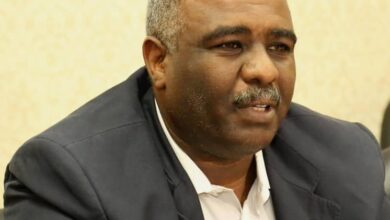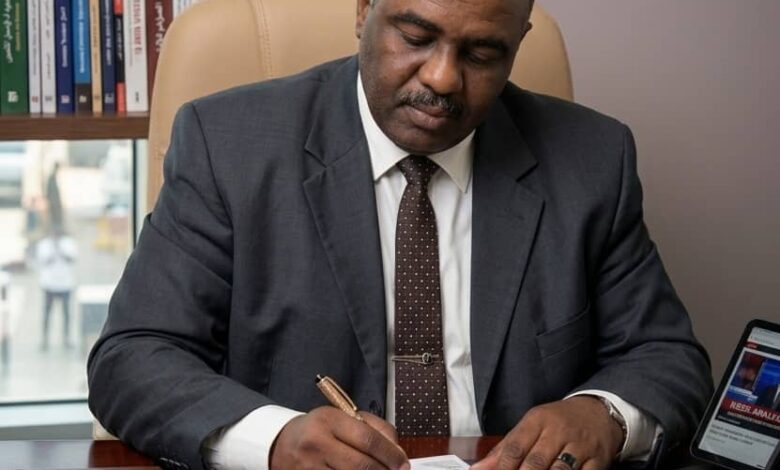
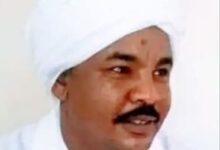
After a long absence from the political scene, Ahmed Haroun’s interview with journalist Rabie Siraj on the Sudan Podcast began to look like an attempt to break the wall of silence and reopen questions surrounding power, the state, war, and the future of the political process. Through its direct engagement with issues that have remained unresolved since the fall of the Ingaz regime in April 2019, the interview went beyond a mere media appearance to revive numerous pending questions about its political significance, the reasons behind its timing, and the calculations shaping the next phase.
What deserves attention is not only the substance of Haroun’s remarks, but also their timing, the way he constructed his narrative, and what he chose to reveal or leave open to interpretation. The man whom Omar al-Bashir delegated in February 2019 to lead the National Congress Party until its general conference convened has returned with a discourse that combines defending the Ingaz experience and explaining its downfall, affirming support for the Armed Forces in the war, and establishing political distance between his party and the existing institutions of government. This gives his appearance a significant dimension that goes beyond recalling the past to attempting to influence the equations of the present.

In explaining the fall of the Ingaz regime, Haroun described what happened as a coup carried out by its own institutions rather than a popular uprising, holding the Security Committee, particularly Salah Gosh, responsible for the failure. Although he came close to describing the events as treason without explicitly using the term, he also refrained from making definitive claims about foreign intervention. Yet the more important question is: How did a regime that ruled for thirty years reach a point at which the fate of the state became hostage to the decisions of a narrow circle of individuals? Here, accountability shifts from the circumstances of the end to the very structure of governance.
This space between accusation and reservation reveals that the narrative of April 2019 remains open to struggles over political memory and the personal accounts of those involved, and that the parties who shaped that period have yet to reach a shared interpretation of what happened. The question, therefore, is no longer simply who brought down the Ingaz regime, but why the state reached that moment, and how the failures of those in power intersected with popular protests, the position of the military institution, and regional and international interactions and ambitions.
In discussing the protests, Haroun revived the issue of disparities between the center and the regions and the absence of federalism. This is a longstanding issue in the structure of the Sudanese state, but it does not justify reducing the popular movement to its geographical locations. Demands are not measured by where protests took place, but by the extent to which they reflected the shortcomings of governance at that time.
In the current war, a notable significance emerges in Haroun’s remarks. The Islamist current has consistently placed military victory at the forefront of its options, viewing negotiations through the lens of implementing the Jeddah Agreement signed in May 2023. However, his remarks this time about an approaching victory, coupled with an acknowledgment of the inevitability of negotiations, reveal a shift in discourse from focusing on winning the battle to considering how to bring it to an end.
Perhaps the most sensitive message in the interview, however, concerned the nature of the relationship between the National Congress Party, President Abdel Fattah al-Burhan, and the Armed Forces. Haroun sought to establish a clear distance between his party and the country’s leadership and government, presenting the party’s participation in the Battle of Dignity as a national position in confronting the war, rather than an organizational relationship or partnership in governing the state.
On the external front, Haroun adopted an open discourse that accommodates regional balances, referring to Sudan’s relations with Egypt, Saudi Arabia, Türkiye, Qatar, and others. Yet his emphasis that managing Sudan’s foreign relations and making use of them fall within the mandate of state institutions carries an important implication, distinguishing between the party and the authority.
Haroun’s statements also raise the question of whether the National Congress Party is seeking to redefine its position at this stage as a force supporting the army without bearing responsibility for the government’s performance or adopting its choices, or whether it is rearranging its relationship with the political landscape in preparation for what comes next. Between these two possibilities, the attempt to separate the position on the war from the position on power appears to be the central thread running through this appearance.
Here, we should not overlook the fact that the National Congress Party is not a passing party in Sudan’s political landscape. It was associated with three decades of rule, marked by transformations, achievements, failures, and crises.
Therefore, any discussion of its return to political life cannot be separated from the questions of review and accountability, or from the Sudanese people’s right to know what happened and assess the experience in all its positive and negative aspects. Supporting the army in the war does not grant any political current an open-ended license to return to power, just as disagreement with the Ingaz experience should not become a justification for excluding it, or denying any citizen the right to political participation in accordance with the law and the Constitution.
What is striking is that Haroun’s appearance was welcomed among sections of the National Congress Party and the Islamic Movement membership, with the reaction extending to segments of the public who saw the interview as an opportunity to hear a narrative that had long been absent. In contrast, the appearance raised concerns among forces associated with the post-December project, foremost among them Sumoud.
Nevertheless, reading the interview as a victory for one political side over another, or as a cause for celebration within National Congress Party circles and concern among its opponents, misses the more important meaning. Sudan does not need to revive battles over memory as much as it needs to draw lessons from them. Nor does it need to recycle political elites as much as it needs to review past experiences and establish a new political contract that accommodates everyone without power-sharing quotas, exclusion, or immunity from accountability.
Here, I am drawn to the poetic memory of Mohamed El-Makki Ibrahim in his poem “Fi Khibaa Al-Amiriya” (In the Tent of Al-Amiriya). In a symbolic reading, the tent transcends the image of a house to embody the meaning of refuge and reassurance, while Al-Amiriya evokes an image of beauty seeking a safe space. From this poetic scene, one can recall the story of a homeland whose door remained open to incursions of power and conflict, until its sense of security gradually receded.
Therefore, the question that goes beyond Haroun’s interview is not merely who stormed the tent yesterday, but why the tent remained exposed, and why political elites, across different eras and slogans, failed to build a home that protects everyone.
From the perspective of #The_Face_of_Truth, Sudan does not need to revive one side’s narrative or exonerate another as much as it needs to reconcile with its history, undertake a courageous review of its experiences of governance, and establish a national contract that makes the state greater than political parties and justice the foundation of the future. Al-Amiriya is not looking for a new guardian of the tent as much as she is seeking a homeland that will never be stormed again, whatever banner those approaching its door may carry.
Wishing you continued well-being and good health.
Sunday, 8 November 2026
Shglawi55@gmail.com