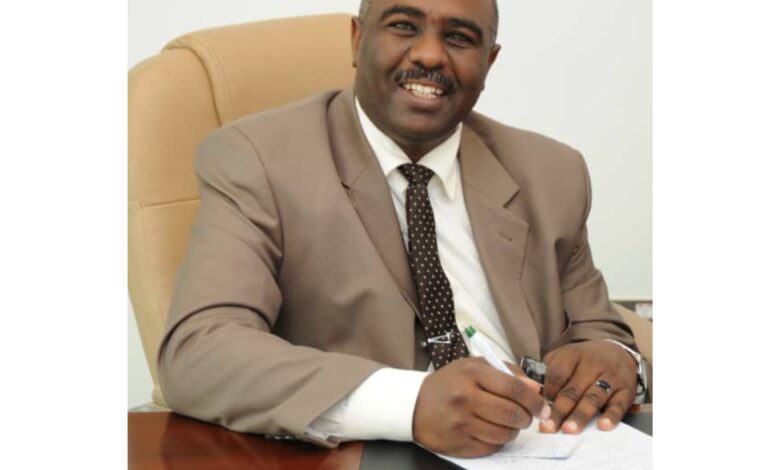
The Face of Truth | Ibrahim Shaglawi
Seven Governors… and No Stability!


In the difficult times that nations go through, countries usually resort to strengthening their financial and economic institutions as a last line of defense against potential collapse. But in Sudan, the opposite seems to be happening. In the midst of a multi-faceted conflict – political, economic, and security-related – the Central Bank of Sudan is experiencing a state of systematic confusion.
The appointment of seven governors within six years, in a country groaning under the weight of inflation, recession, and currency depreciation, is not merely an administrative flaw, but a clear expression of the absence of institutional will and lack of vision. Amid the decisions of dismissal and appointment, the opportunities to build solid institutions are lost, the spaces for proper planning vanish, and with them disappears the most crucial thing the country needs in this critical historical moment: stability.
Since the fall of the Bashir regime in 2019, no government has succeeded in establishing the independence of the central bank as stipulated in the constitutional document. It is enough to recall that famous scene when former Prime Minister Dr. Abdalla Hamdok was asked about the authority to which the Central Bank reports, and he hesitated and referred the matter to the head of the Sovereign Council, even though the document clearly stipulated its subordination to the Prime Minister.
The decision to dismiss Governor Dr. Burai Al-Siddiq and appoint Ms. Amina Mirghani Al-Tom as his successor may seem to some as just a routine change, but a deeper reading reveals it is a continuation of a flawed equation in which the Central Bank is used as a tool for settling political scores and advancing temporary agendas, rather than as the spearhead of national monetary policy.
It may be understandable to reject an official’s vision if it conflicts with state policies, but what is concerning in the Sudanese context is that dismissal has become a tool for political maneuvering, not for correcting professional paths. Changes at the top of the banking hierarchy often occur without clear announcements of the reasons and are linked to disputes within ministerial meetings or conflicts over sensitive issues, as recently happened in the disagreement between the dismissed governor and the Minister of Finance regarding the Central Bank’s control over gold exports.
The appointment of Ms. Amina Mirghani, the first woman in Sudan’s history to assume this position, on the surface carries a positive message regarding the empowerment of women and the utilization of national competencies. However, the challenges she faces are immense; the position she is entering is not one of symbolic representation but a complex political-economic battleground that requires more than just an impressive resume.
Success in this position depends on her ability to impose a minimum level of independence, resist interference, and establish a comprehensive vision that restores the Bank’s natural role as an institution leading monetary policy, not an executive apparatus for top-down directives.
The recent Lebanese experience in 2019 offers a profound lesson, when Banque du Liban, once one of the region’s leading central banks, became the heart of the crisis. The Lebanese state maintained an artificially fixed exchange rate for decades while monetary policies deteriorated. The central bank was used to finance the deficit, and the markets were left in the grip of political and banking interest networks, resulting in an economic explosion in which citizens lost trust in the currency, the bank, and the state itself.
The resemblance between the two experiences is clear: lack of independence, politicization of monetary decisions, conflict between the Finance Ministry and the Central Bank, and patchwork solutions such as monopolizing gold or printing money without controls. All are signs warning of a reproduction of the Lebanese scenario in a more fragile Sudanese version.
But the difference is that Sudan theoretically still has a chance to survive, provided there is first an acknowledgment that the real challenge is not in changing individuals, but in rebuilding the system and the law. This begins with restoring the independence of the Central Bank, regulating the relationship between politicians and professionals, achieving harmony between fiscal and monetary policies, and opening the Bank to the banking and international communities.
The appointment of Ms. Amina Mirghani presents a real test of the Sudanese state’s ability to transition from improvisation to vision, and from crisis management to institutional management. What matters is not who sits in the governor’s chair, but whether the authority can respect task boundaries and separate the economy from the conflict of interests.
Sudan today does not need a new governor as much as it needs deep institutional reform that rebuilds trust between the citizen and the state. Every time a governor is replaced due to a political disagreement rather than a professional failure, the people pay the price from their livelihood and their future.
As for Ms. Amina, her success or failure will not be measured by the number of decisions or intentions, but by her ability to withstand interference, impose real independence for the Central Bank, and restore the lost trust in national institutions.
And the fundamental question remains, according to #TheFaceOfTruth: Are we witnessing a moment of real reform? Or just a new chapter in the drama of instability?
Stay well and in good health.
Wednesday, October 15, 2025
Shglawi55@gmail.com