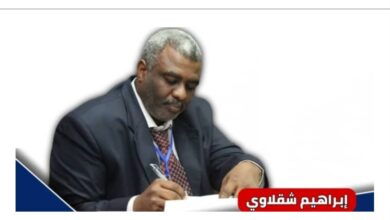
Face of Truth | Ibrahim Shglawi
Sudanese Universities.. The Challenge of Survival..!


Last week, the Ministry of Higher Education announced the university admission results for the academic year 2023–2025, amid challenges that threaten the structure of higher education and place the future of thousands of students at a crossroads. The universities that were destroyed by the war have become a manifestation of a crisis that may relate to the very vision of education, its feasibility, and its place in the project of the modern Sudanese state after the war.
Despite the technical efforts consistently exerted by the Ministry of Higher Education to ensure fairness in admissions, the numbers reveal that more than 40% of eligible students refrained from applying to public universities. This figure cannot be separated from the repercussions of the war, the loss of confidence in educational outcomes, and the declining attractiveness of disciplines that once represented pillars of national renaissance.
In light of the radical transformations the world is witnessing today, curriculum development and college modernization have become an inevitable necessity for any educational institution. While neighboring countries are taking rapid steps toward integrating artificial intelligence, the Internet of Things, and robotics into their educational systems, most Sudanese universities remain stuck in traditional models that do not align with the nature of the emerging knowledge-based economy.
Perhaps the most striking paradox lies in students’ reluctance to enroll in majors such as physics and mathematics, or agriculture, industrial engineering, and education—disciplines that are considered today in many countries as the foundations of the Fourth Industrial Revolution.
Does this mean that universities have not updated their vision for these disciplines? Or do students see them as gateways to a dead-end future with no real employment or practical prospects? In any case, this reluctance places us before the necessity of revisiting the philosophy of education, its directions, and its domains in a way that aligns with the vision of the new Sudanese state.
Despite the ongoing deterioration, the University of Khartoum still maintains its symbolic and academic standing. But this “old luster” alone is not enough in an era where universities are required to be dynamic centers for creativity and development, not mere repositories of theoretical knowledge. In reality, the status of universities today is measured by their connection to the job market and their ability to produce employable knowledge—not just by their historic legacy.
Official statistics also reveal a distorted educational map, as the states of Darfur, South, and West Kordofan have become effectively closed off to higher education due to the control of the Rapid Support Forces militia and the absence of state institutions. This closure contributes to deepening the developmental and societal gap between the center and the periphery and may threaten the future of education in these states—forewarning of a buildup of causes for future political and social instability.
It is noticeable that a considerable percentage of students have turned to private universities such as the National University and Ahfad University, despite the general decline in demand for higher education. However, this shift—although it gives the impression of alternatives—also reveals the limited options available to students, especially given the wide disparities in quality between private and public institutions, and the financial costs that exclude large segments of students.
From this scene, the war has demonstrated that the Sudanese student is not merely a passive recipient, but an active participant in national affairs. Thousands of students responded to the call of popular resistance, carried arms, and provided logistical and media support to the armed forces. This experience should not be forgotten but should be transformed into an integral component of the educational process: we need an education that graduates students who know how to love their country—not how to leave it.
The goal is not to militarize education, but to build solid civic awareness through curricula that teach the concepts of national service, crisis management, national security awareness, and linking knowledge to the national context. Universities must become research centers for issues of disasters, emergencies, and conflicts, alongside technology.
Equally important are the experiences of thousands of students who found themselves outside Sudan and enrolled in universities abroad, returning with different experiences in teaching methods, administrative structures, and the use of modern science. This group represents a knowledge resource that must be utilized—alongside Sudanese professors in the diaspora—to formulate a new vision for higher education.
From here, according to #Face_of_Truth, the development of higher education becomes a national project. It begins with restructuring universities, updating curricula, stimulating scientific research, and linking it to the needs of the market and society. There can be no development without education, no security without education, and no future without education. The choice for our country has become clear: either serious and radical reform of the educational system in line with the times—or remaining stagnant in outdated models that fuel despair and deepen the gap between the citizen and the state.
Wishing you health and well-being.
Tuesday, August 9, 2025
Shglawi55@gmail.com