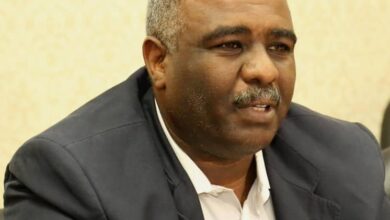
The Chairman of the Transitional Sovereignty Council and Commander-in-Chief of the Armed Forces, General Abdel Fattah Al-Burhan, greeted the Sudanese people and the martyrs of the Battle of Dignity on Friday, during his address to worshippers at the mosque and religious center of Sheikh Al-Tayeb in Um Marahi, Omdurman.
However, the significance of the speech went beyond the occasion itself, given its political timing, as it came amid escalating discussions about ceasefire initiatives and the circulation of leaks regarding new negotiation tracks that are shaping the features of the coming phase.


During times of crisis, leaders’ speeches cannot be read separately from their context, as they become tools for defining positions and drawing the boundaries of political movement. Therefore, Al-Burhan’s affirmation that the Armed Forces “will not hand over this state except through national consensus among Sudanese people,” and that any path that does not achieve the security and stability of Sudanese citizens will not be acceptable, came as a declaration of the political ceiling within which Khartoum is operating: a peace that ends the causes of the war and preserves the sovereignty of the state.
From this perspective, the importance of the leaked American document emerges as an indicator of the nature of the international discussion surrounding ending the war. The document included a 90-day humanitarian truce, and United Nations mechanisms for limited withdrawals as a prelude to a permanent ceasefire and a transitional political process. However, reading such documents cannot be based solely on their texts, but rather on their context and the experiences of the parties with previous agreements.
The document reveals points of agreement between Khartoum and Washington regarding Sudan’s sovereignty, the cessation of foreign interference, and the establishment of a unified national army. Yet the fundamental disagreement remains over Sudanese domestic concerns that the truce could become an opportunity for redeployment and the strengthening of combat capabilities, as occurred in previous experiences, making any ceasefire dependent on genuine guarantees preventing the repetition of the same scenario.
Here precisely lies the reason behind Khartoum’s firm rejection of the idea of limited withdrawal proposed in the document, and its insistence on the withdrawal of the Rapid Support Forces from all cities and civilian areas they have controlled since the outbreak of the war.
From the perspective of the state, the issue is not merely related to military arrangements, but rather to the political outcome of the war. The government fears that temporary measures could turn into a permanent reality that reproduces the crisis under the title of peace, while it believes that sustainable peace begins with restoring the state’s legitimate monopoly over the use of force.
On the other hand, the leaks themselves appear to be part of negotiation management tools. Such documents are rarely leaked without political calculations; rather, they are used to test reactions, prepare public opinion, and exert indirect pressure on the parties. Therefore, Al-Burhan’s speech was not merely a response to the content of the document, but also to the method of managing the scene, by reaffirming the red lines before domestic public opinion, before the leaks turn into assumed political facts.
The speech did not direct its messages only outward, but inward as well, as the space of consensus expands around the requirements of the day after the war, foremost among them ending the multiplicity of armies, restoring the state’s monopoly over force, and rejecting any settlement that reproduces militias or prolongs the conflict. The Sudanese negotiator derives strength from the internal support he receives on issues of statehood and sovereignty.
Nevertheless, negotiation management continues to require a delicate balance between secrecy that protects the details of talks and transparency that strengthens citizens’ confidence and prevents the exploitation of leaks to create alternative narratives. International experiences confirm that clarity regarding the general principles of negotiation does not weaken the state’s position; rather, it provides it with broader political support in confronting external pressures.
Perhaps the most dangerous aspect of the leaked document is that it moved beyond security arrangements to outlining the features of the upcoming political process, including discussion of excluding certain currents or groups from dialogue. This is a sensitive issue, because determining participants and exclusions remains a sovereign matter for Sudanese people, not a decision imposed by external platforms. The legitimacy of any political process is not built on exclusion, but on law and the will of the people.
From this standpoint, the criterion for the coming phase should be linked to positions regarding the state and its institutions more than partisan affiliations. Whoever supported the state is subject to the standard of national participation, and whoever faces accusations of violations or crimes should be judged by the judiciary. Political mandate, meanwhile, remains a right determined by the people through free elections, not through closed understandings or external pressures.
In the same context, civilian transition does not mean the return of any political forces to power without popular mandate. Rather, it means building a foundational phase based on national competence, rebuilding state institutions, and preparing the way for free elections in which the ballot box becomes the source of legitimacy. Democracy is not imposed through documents or external settlements; it is built through national will and stable institutions. Therefore, the essence of the coming phase is linked to the nature of the state that will emerge from the war. The political battle runs parallel to the battlefield:
between external pressures seeking to influence the outcomes of the conflict, and a Sudanese vision that believes true peace means restoring the state and preventing the reproduction of the causes of the crisis.
According to #TheTruthPerspective, reading Al-Burhan’s speech as a passing statement overlooks its political significance. At every negotiation stage, it becomes a tool for defining the ceiling of movement before international platforms or media leaks define it. Peace is not rejected, but Sudanese people who have paid the price of this war with their lives and properties, and endured the bitterness of displacement and exile, believe that the future of their country can only be shaped by their own will. Exiting the crisis does not come through reproducing the causes of war, but through building a state that restores its sovereignty, with its people determining its political form through law and free choice. Without dictates from anyone.
Wishing you continued health and well-being.
Friday, 10 July 2026
Shglawi55@gmail.com