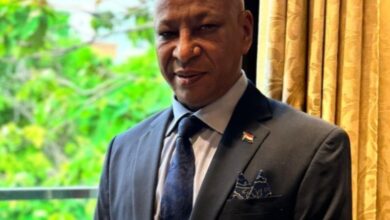
*And Despite Expectations..* *Abdel Moez Hussein Mukabarabi* ### When Strategy Becomes Chaff Scattered by the Wind and a Question Resistant to Deconstruction…!?

Experts in strategic knowledge affirm that the greatest threat to state sovereignty is the absence of a strategic framework that defines the goals, objectives, and interests of the state and its pathways amidst the intersections, entanglements, and interferences in the circle of international conflict, and that the most dangerous threat to the national security of states is for the same reason. The absence of a strategic vision in Sudan means the absence of a clear and specific plan to achieve national goals, which leads to instability. The absence of strategic vision leads to political, economic, social, and security instability.
As well as conflict of interests: without a strategic vision, personal and factional interests become dominant, leading to conflict of interests.


In addition to weak performance: the absence of strategic vision leads to weak government performance and inability to achieve goals. And dependence on the outside: without a strategic vision, Sudan becomes more dependent on the outside, which weakens national sovereignty. And deterioration of the economic situation: the absence of strategic vision leads to increased poverty and unemployment. And weak infrastructure: the absence of strategic vision leads to weak infrastructure and inability to provide basic services.
And deterioration of the security situation and increase in conflicts. There are reasons for the absence of strategic vision: weak political and administrative leadership. And conflict of personal and factional interests. And political and economic instability. And excessive dependence on the outside. The solutions are to develop a clear strategic vision to achieve national goals. And to strengthen political and administrative leadership. And to develop infrastructure and provide basic services.
And to promote political, economic and social stability… In Sudan, coffee is no longer just a cup sipped slowly, nor a passing session to exchange news and stories; it can become a space for reflection on the conditions of the homeland, reviewing its decisions, and reading what is going on around it in terms of conflicts and interests.
From here, we raise the coffee cup and ask: Where does Sudanese sovereignty stand amidst these storms? Sovereignty is not just a flag fluttering over institutions, nor a political discourse singing of independence of national decision. True sovereignty is that Sudan possesses its own will, and that its decisions are formulated based on the interests of its people, not in response to external pressures or calculations of powers competing for influence, wealth, and strategic location.
And Sudan, with its natural resources, agricultural lands, water, mineral wealth, and extremely important geographical location, is not a marginal state in regional calculations. But the question that should concern us is not only: What do others want from Sudan? But also: What does Sudan want for itself? The war that has exhausted the country does not only put before Sudanese the challenge of stopping the bloodshed, but imposes on them a deeper review of the nature of the state, its institutions, mechanisms of decision-making in it, and its regional and international relations. The state that does not have a clear strategic vision becomes more vulnerable to its lands turning into an arena for settling scores, and its resources turning into a subject of competition, and the future of its people becoming hostage to balances in whose formulation it does not participate. Sovereignty does not mean isolation from the world, or hostility to countries, or rejection of international cooperation. Rather, it means building balanced relations with everyone, based on mutual interests and respect, and rejecting interference in internal affairs, whatever its source. Sovereignty is also not reduced to the position towards a specific state, nor measured by the high tone of political discourse; rather, it is measured by the ability of the state to protect its citizens, preserve the unity of its lands, manage its resources, and make its decisions independently and responsibly. And at the heart of this equation stands the Sudanese citizen, who has paid a heavy price for war, displacement, asylum, and collapse of services. There is no meaning to sovereignty that does not protect the human being, and no value for independence of decision if it is not reflected in security, dignity, justice, and opportunities for life. So the sovereign case here is not a platform for distributing accusations, nor a podium for political flattery; it is an attempt to ask difficult questions, discuss unspoken files, and search for Sudan’s interest amidst crowded conflicting interests.
Can Sudan move from the position of a state that receives the influences of others to the position of a state that makes its own choices and defends its interests?
That is the question that deserves to be put on the table, to be deconstructed and probed, awaiting an answer not made by speeches, but made by a deep and comprehensive strategic vision and effective institutions and a solid national will and peoples who are strategically aware and conscious, who comprehend transformations and challenges and know how to deal with all possibilities to be able to open windows of hope to foresee the future, and this is not impossible and we see it as near..
…And God is the Helper..