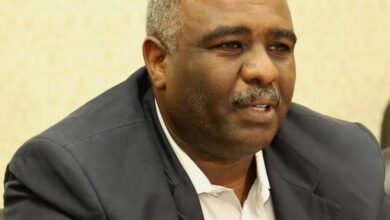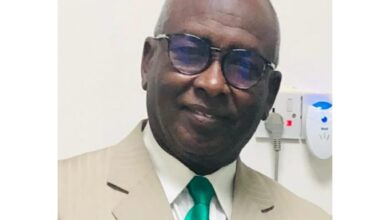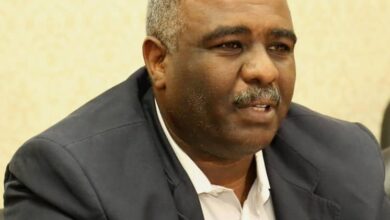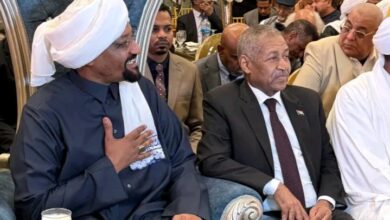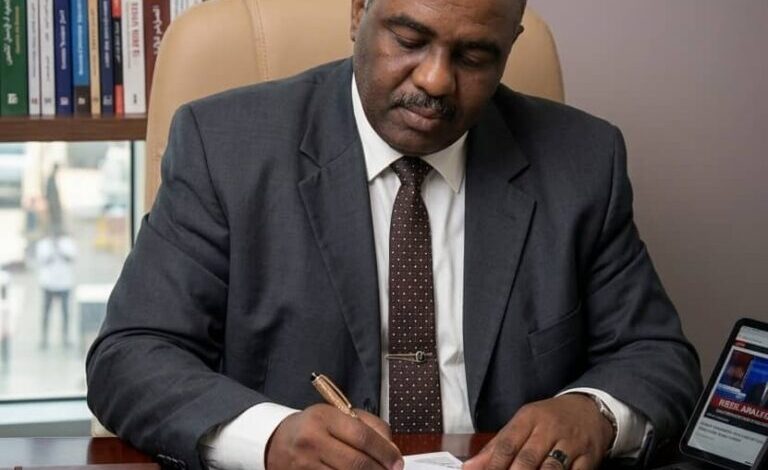
Four hours of dialogue between Mr. Mustafa Al-Batal and Ahmed Haroun, Chairman of the National Congress, ended with a conclusion that is difficult to pass over without pausing: the writer says, “I came out of the meeting filled with optimism, abundant confidence, and deep reassurance about the future of Sudan.” What is striking is that the reassurance came out into the open, while the substance of the conversation remained “off the record.” Here begins the question of our article: What did Haroun say to Al-Batal that made him leave the meeting with such a degree of reassurance?
The writer deliberately refrained from revealing the substance of the conversation, contenting himself with the overall impression it left on him. Nor can we say with certainty which came first: the meeting or the statement issued by the National Congress on Wednesday, which began by focusing on the challenges facing the country.

Yet their coincidence may explain one another, without necessarily implying a causal relationship between them, for politics is read through the intersection of statements and contextual circumstances.
Al-Batal’s remarks about Haroun evoke the image of the man from his previous experience as governor of North Kordofan, linking it to urban and development activity, and to his ability to bring his supporters and opponents together around the state’s project. He then moves from a personal impression to a political conclusion based on confidence in the man, and then confidence in the cohesion of the National Congress and its ability to remain present and act.
There is also a political significance in the choice of Mustafa Al-Batal that deserves attention. He is not an ordinary messenger; the man has weight, credibility, and regional and international contacts. In politics, the choice of the intermediary is part of the message. Therefore, Ahmed Haroun’s appearance through him at this particular time seems closer to testing the waters and assessing the possibility of restoring political presence, without necessarily being an announcement of the starting shot.
Here the idea changes. The issue is no longer Ahmed Haroun, but rather the National Congress as Al-Batal wants to see it in the Sudan of tomorrow: a cohesive party, widely spread, deeply rooted, supportive of the army, and convinced that the priority of the current phase is preserving the unity of the country, without being in a hurry to challenge the authority currently in place.
Yet the legal dilemma concerning the procedures for dissolving the party remains. Legal experts argue that the decision was not based on the Political Parties Act, but was taken within the context of political conflict and settling scores. Consequently, excluding the party cannot be settled by a political decision alone, but rather by the law, the legitimacy of the procedure, and the will of the voters.
But beyond that, the reassurance Al-Batal spoke of becomes more ambiguous. Perhaps the reassurance was not merely about the organization’s cohesion or its position toward the army. Perhaps Al-Batal saw in Haroun’s words something beyond that: a vision of the National Congress’s capacity to act on the issues that will shape Sudan in the coming phase, foremost among them the economy, politics, and foreign relations.
The National Congress, by virtue of its long presence within state institutions, has accumulated extensive experience in administration, economics, and regional and international relations. This does not mean that it is managing the current scene from behind the curtain, nor does it prove the accusations that place it in a position of direct influence over political decision-making. But it does mean something simpler and more important: it is an organization whose accumulated knowledge, experience, and networks of relations are difficult to ignore when discussing the balance of influence in the country.
Here, the reference in the National Congress statement acquires political weight. Its linking of the war to the economy, coinciding with Al-Batal’s remarks about the party’s capacity for presence and action, suggests that the economy and regional and international relations may serve as bridges for the party’s return to the political scene, in a complex Sudanese reality that requires such avenues.
A party possessing cadres and expertise accumulated through a long experience in managing the state may, in theory, be capable of offering something in a moment of economic crisis, whether through ideas, expertise, or networks of relations. But potential capacity to influence is not evidence of actual influence, and this distance must be taken into account.
The same applies to the external sphere. The country’s crisis is no longer an internal matter, as regional and international interests have become intertwined within it, and any sustainable settlement has become linked, to varying degrees, to the positions of regional and international powers, as well as pressures, alliances, and negotiations.
In such a landscape, foreign relations, diplomatic experience, and networks of political communication become part of the tools of influence.
Sudan will not emerge from the war through military force or politics alone, but through reshaping its network of regional and international relations and transforming the outside world from a space of pressure into a field for negotiation, mobilizing support, and reconstruction.
If the National Congress possesses some of the tools for such a course, then the significance of the “deep reassurance” written by Al-Batal remains open to more than one possibility: perhaps military assessments, party cohesion, or potential political, economic, and external shifts.
It is clear that Ahmed Haroun’s emergence from silence was calculated. The choice of Mustafa Al-Batal, the reassurance with which he emerged, and the coincidence of the meeting with a new political and economic discourse from the National Congress make the appearance seem closer to testing the waters for a possible political return.
Therefore, the significance of the four hours lies not in what was said, but in what Al-Batal heard that made him leave with that reassurance. Here, “What Did Haroun Say to Mustafa Al-Batal?” goes beyond the boundaries of the meeting to become an early test of the National Congress’s position in the post-war equation, and what was not said inside the room may be the first thing politics will reveal.
Wishing you continued health and well-being.
Saturday, September 19, 2026
Shglawi55@gmail.com